
Written by Richard Durrance on 20 Feb 2026
Distributor NA • Certificate 12 • Price NA
Though a lot of anime finds its way into the west, in the Japan Foundation’s Touring Film Programme is showing only one: The Last Blossom. Directed by Baku Kinoshita, director of the wonderful Odd Taxi. It’s only right then that someone went to check it out.
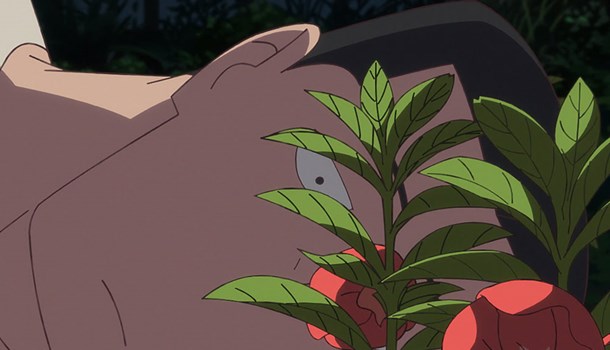
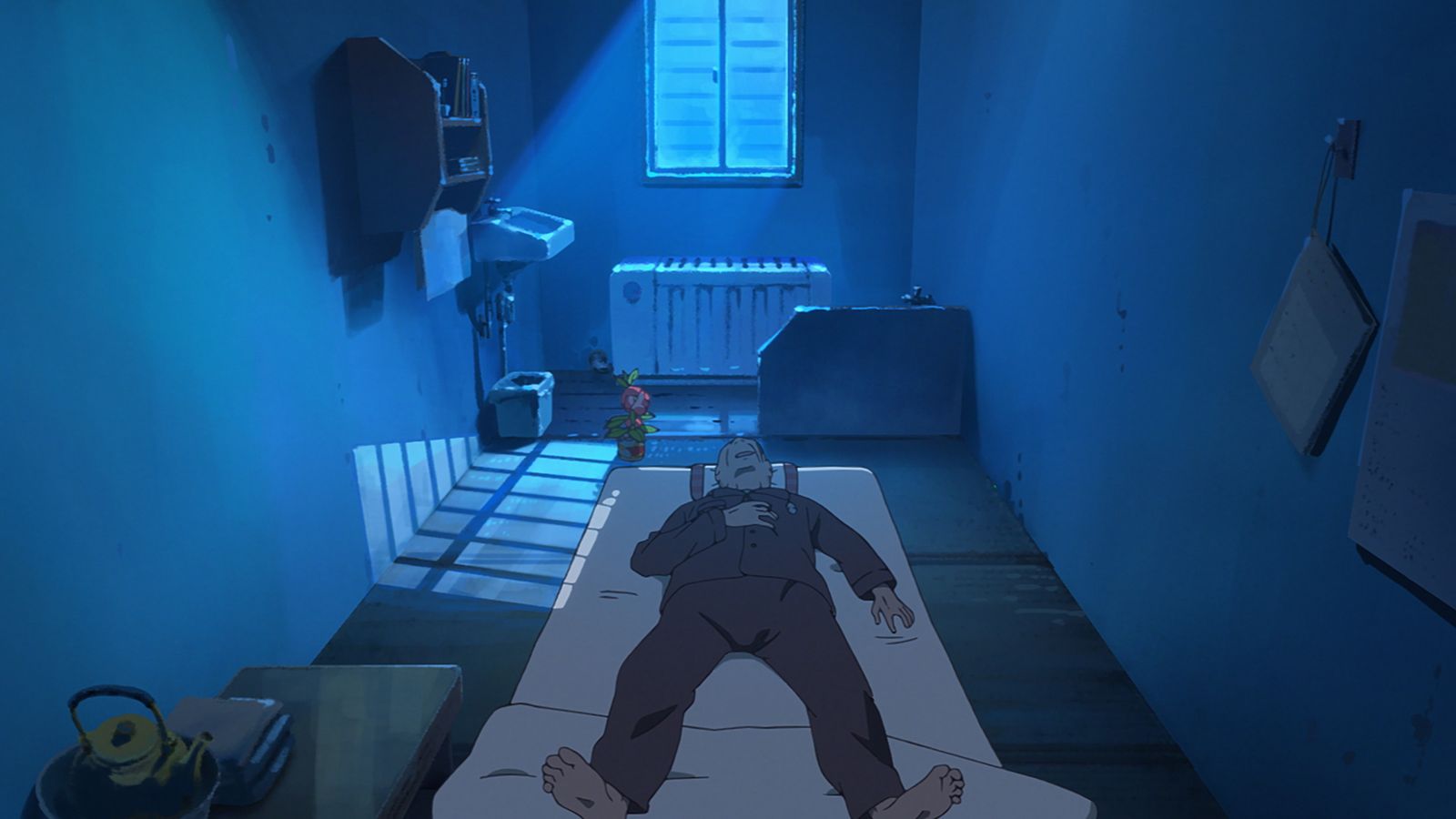
Aging yakuza Akutsu (Kaoru Kobayashi as present self; Junki Tozuka, young self), is dying in prison with no one else to talk to, no one except a talking balsam plant (Pierre Taki). Their conversations take him back to his past, where he takes in single-mother, Nana (Hikari Mitsushima, past self; Yoshiko Miyazaki, present self), and her baby son, Kensuke (Natsuki Hanae, present self).
As with all live TFP screenings, there’s a short intro, in this case from the programmer herself and her observation is not unreasonable that in the current tranche of anime there are few that deal with the yakuza. True, sometimes as a force or a set of villains, but it tends to be better served with live-action rather than anime. This 90-minute film is a bit of an unusual one but arguably all the better for it. There is an aspect of the surreal; Akutsu talks to a plant and the plant talks back, it gesticulates, it moves about in the can in his prison cell – though noticeably it does not have a face, but its gestures speak as much as any expression. It’s not just here that this balsam plant speaks and watches, it is one of many that are connected together, whose memories can be shared. Outside the home Akutsu shares with Nana in flashbacks, the plant is just as vocal and often just as mocking as it is in his cell, even if no one can necessarily hear it. The plant is just as much a character as anyone else we meet, and its nature becomes very important to the story as it unfolds.
It's an intriguing tale indeed and potentially a difficult one because it needs not only to balance the surrealist aspects of talking, moving, gesticulating plants, but with Akutsu’s relationship with Nana and her young child, as well as Akutsu as a yakuza. These varying aspects could clash tonally with ease, though somehow it’s no surprise that the director of Odd Taxi slots them together with apparent ease, the sort of "ease" that you suspect is only possible through great effort and significant skill.
Akutsu and Nana live platonically. But not. She speaks of getting married. You know that she knows that Akutsu loves her, loves her son, even if he will not speak of it. He’s clear enough to say the wife of a yakuza is hard. She accepts this, even if he will go no further than saying that. You know that nothing can and ever will happen; but this does not ever deaden the sense of feeling between the two. If anything the lack of consummation heightens the emotions between the two characters. They live with and accept the denial of feelings, if uneasily, even if at one point Akutsu goes off the rails, but this is almost in passing, a sidebar to the real emotional core, which is his unresolved feelings for Nana and young Kensuke. The balsam plant mocks him mercilessly for coldly refusing to admit his feelings to Nana, or to the young boy, but this is his character, to explosively acknowledge anything would be to undermine who Akutsu is, and also, importantly, his seething emotions become clearest in how he finds himself in jail, as his superior yakuza, Tsutsumi (Hiroki Yasumoto) inveigles him in activities that Akutsu accepts out of love.
I won’t get into spoilers of what that is or where it leads, but tonally it resonates because it illustrates Akutsu’s character in its entirety, the man who is in love but cannot fully commit or accept it; it recognises him as Akutsu the yakuza, able to be part of horrific violence. It is Akutsu as a yakuza that understand how they think, feel and act, indeed how he must think, feel and act to enable himself to meet the ends that he seeks to have. Ultimately, too, he is willing - as yakuza often are - to accept the cost for what he has done, what he has witnessed, even if the justice of it is nothing of the sort because this is how he is able to fully illustrate his feelings; importantly here he trusts that Nana understands. There does not need to be communication to say yes, she does, as that is arguably love in its truest state (reminiscent of aspects of Hal Hartley's Trust), where there is a quiet surety that requires no language and no confirmation.
This connection Akutsu feels he has to Nana, even if he has spent decades in prison with no words from her, is echoed inn how the balsam plant has tendrils of connections to its other selves, its other plants outside the prison. Akutsu is his own balsam plant.
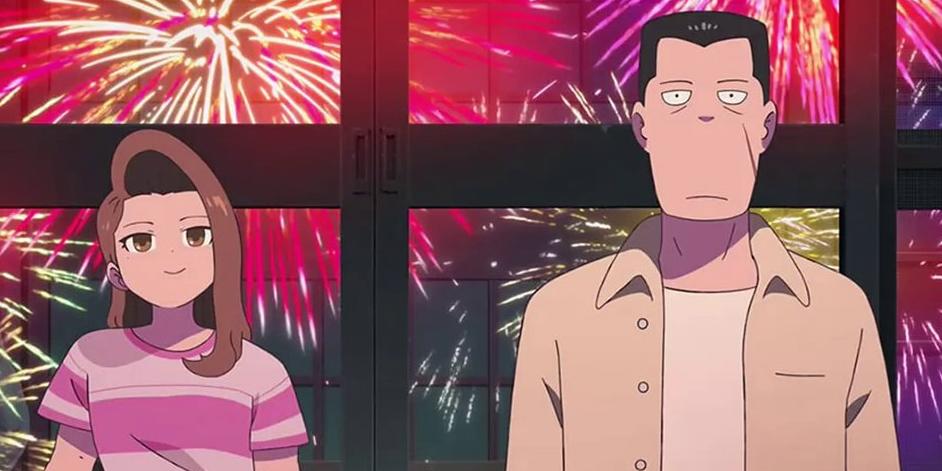
The animation is often muted. It’s not crying out to be noticed in the manner of Belle, though it has its moments of potency, such as the fireworks that explode and lead into its title sequence (and importantly when they reappear later illustrate how the world has changed). That's not say it's poorly animated, rather it focuses on the detail, such as the games of Othello that Nana and Akutsu play; it comes to the fore in the wonderful gestures of the plant as it shouts its rebukes to the characters (unheard or otherwise). I admit I had not twigged that the young Nana was voiced by Hikari Mitsushima, who seemed to be everywhere in the mid-to-late 2000s and early 2010's, then seemed lost to TV (or at least to western audience, much to my dismay), which makes me smile as I really liked her vocal performance with realising it was her – I do love some positive reinforcement of why you like what you like.
The film rarely puts a foot wrong. I would argue that there is a small flourish at the moment that provides an emotional confirmation that the film should have omitted; it’s unnecessary but it is also not made a big thing of – though some of the “oooohs” in the audience behind me suggest that though it’s only on screen for a moment it’s impact was significant (as was that of the person behind me who kept annotating the film.... but they were enjoying it so I it was forgivable... just).
The Last Blossom’s understated emotions are ultimately what makes it a rather lovely, softly emotive film. I would like to see more films like it come to the west. I’m sure we’ll see more of it soon, as AllTheAnime have licensed it.

Long-time anime dilettante and general lover of cinema. Obsessive re-watcher of 'stuff'. Has issues with dubs. Will go off on tangents about other things that no one else cares about but is sadly passionate about. (Also, parentheses come as standard.) Looks curiously like Jo Shishido, hamster cheeks and all.
by Ross Locksley on 19 Feb 2026

by Ross Locksley on 08 Feb 2026
by Ross Locksley on 25 Jan 2026
by Ross Locksley on 01 Jan 2026

by Ross Locksley on 21 Dec 2025
by Ross Locksley on 25 Nov 2025

by Ross Locksley on 24 Nov 2025
by Ross Locksley on 11 Nov 2025