

Written by Richard Durrance on 03 Feb 2026
Distributor NA • Certificate NA • Price NA
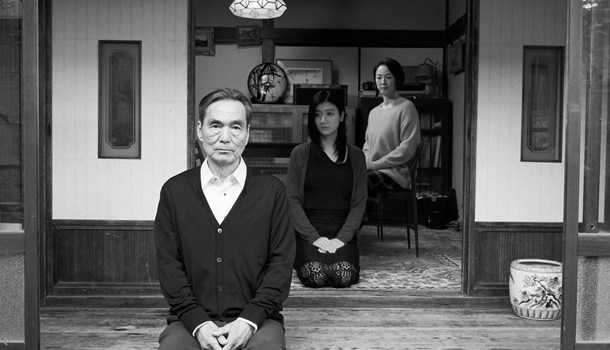
Of the screeners sent for films showing at the Japan Foundation's Touring Film Programme, Teki Cometh stood out for being both recent (2024) and shot in black and white. Now, as far as I’m concerned black and white is often used much better cinematically than colour so for me is like a giant sign: watch this movie.
So what would I make of Daihachi Yoshida’s (Funuke Show Some Love, You Losers!) film?
Retired French literature professor, Watanabe (Kyozo Nagatsuka), lives his quiet life, working part time and occasionally seeing his old pupils. Slowly though his mind starts to fray, memories of the past merging with his present and his darkest thoughts start to become exposed.
Teki Cometh is a difficult film to sell in many ways because it is something of a slow burn film. The opening, wherein Watanabe goes about his regimented life, getting up, cooking breakfast, grinding coffee in a little hand-cranked grinder, working on articles commissioned for kindness by his ex-pupils and eating lunch is filmed with careful lucidity. Something about the minutiae of it is almost fascinating, because it feels like it’s documenting a real person. Scenes where someone comes to help him possibly repair his outside well, or another when he’s interrupted by his neighbour as he accuses a dogwalker of her pet soiling the pavement (followed by a sequence that if anything shows Watanabe’s clarity of mind and emotions), you feel you are watching the life of a real person and there’s something quietly compelling about it.
Then Watanabe finds himself possibly with a bladder disease and his mind starts to give way. Or, let me put it differently, Watanabe gets another junk email that says that teki (the enemy) are coming, and his mind starts to give way. If there is a problem with the film and the adaptation of its literary source (about which I cannot comment for ignorance), it seems to have this email as the cause of his mental disintegration. In the film it seems more of an aside, a junk email that appears a few times and then suddenly takes over his Apple computer, but the reason why seems a bit overblown. Considering the film suggests he may have bowel cancer (though it also suggests it may just be a result of some spicy kimchi) and suddenly facing death – he's a widower and tells a friend he's not had a health check in ten years because it would be better to die – this seems a far more realistic motivation in the film’s narrative for his decline.
As Watanabe’s mind starts to give at the edges and we start to truly see inside his mind, there is a period where the film lacks an element of clarity. Considering the sheer lucidity of the opening, I felt that the story struggled to segue into where imagination and reality because diffused; often the split is broken by Watanabe waking – just as how the film is split by the seasons – though this changes greatly towards the end where arguably it becomes more effective as it becomes more crazed visually. The shots of Watanabe with the camera up close and tracking his movements coupled with the eerie teki advancing effectively capture his distress. Equally the momentary images of the dirty, unclean teki, suddenly in his home, have a raw Lynchian nightmarish quality to them (and it’s visual iconography could very likely be borrowed from Twin Peaks Series 3, Episode 8 – yes, that episode “Gotta light”) .
Though the film struggles to really explain the cause of Watanabe’s mind unravelling it’s still effective and sometimes disturbing. Disturbing more for how it shows that this apparently strict professor of French was capable of significant self-delusion about his own behaviour, something you suspect people were aware of and were forced to accept. Not that all of his loss of mental cohesion is serious. A second colonoscopy turns into an enforced S&M nightmare (literally), so the film is not unwilling to have fun and it is also happy to be ambiguous. At one point Watanabe believes himself to have been scammed, but at this point in the film we have so little frame of reference as to what in the apparently everyday is real or not that we have no clear idea as to whether or not it's real. What matters is that he believes it, at least for a moment.
Again there is perhaps a problem here. If the film were more clearly investigating the emotional distress of a mind unravelling, of a developing dementia and how that in and of itself multiplies the distress, the knowing of the decline and the difficulty in stopping it, it would be more emotively effective; but because the cause is other, it reduces some of the effect because too often we as a viewer find ourselves stopping to ask: am I missing something? The teki concept just seems to get in the way.
Though we do have a cast of characters that enter and exit, the film is almost a single-hander, with Kyozo Nagatsuka as Watanabe, and when you consider that there’s almost never a moment when he’s not on screen you cannot help but be impressed by his performance. Moving between the calm of the everyday to thee terrified distress of his situation, through to recognising the secret desires he dares not admit, Nagatsuka quietly excels in the role.
The film may lack a sense of clarity, due in part to the source material (and when you consider Paprika is one of the other novelist’s work to have been translated to the screen you can understand why – PS, Paprika is resolutely my favourite of Kon’s film), but there’s still real skill here when you get into the defining moments of the film, whether it's the delicate calm of retired life or the distress of knowing your mind is not fully under your control. Kyozo Nagatsuka’s performance and that of the cast around him still make this an eminently watchable film.
Teki Cometh is screening as part of the JF Touring Film Programme and screenings can be found here.

Long-time anime dilettante and general lover of cinema. Obsessive re-watcher of 'stuff'. Has issues with dubs. Will go off on tangents about other things that no one else cares about but is sadly passionate about. (Also, parentheses come as standard.) Looks curiously like Jo Shishido, hamster cheeks and all.
posted by Richard Durrance on 27 Jan 2026
posted by Richard Durrance on 19 Jan 2026
posted by Richard Durrance on 08 Jan 2026
posted by Richard Durrance on 17 Dec 2025
posted by Richard Durrance on 12 Dec 2025
posted by Ross Locksley on 09 Dec 2025
posted by Richard Durrance on 28 Nov 2025
posted by Richard Durrance on 25 Nov 2025