
Written by Richard Durrance on 25 Feb 2026
Distributor Eureka • Certificate 15 • Price £17.99
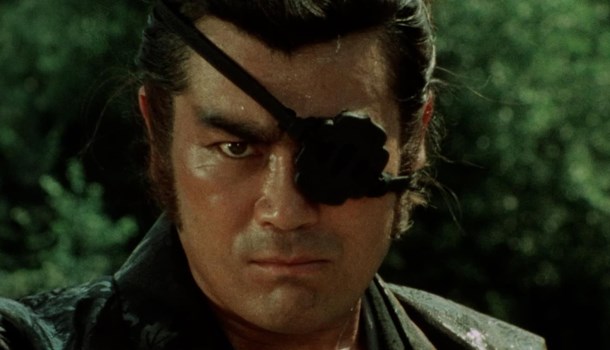
Welcome to another of Kinji Fukasaku’s samurai films, his 1978 Shogun's Samurai, or as it was known in Japan The Yagyu Clan Conspiracy.
Another release directed by Fukasaku is always a welcome event. Have I seen a bad Fukasaku film? Not that I recall, though arguably Message from Space, his pre-emptive Star Wars clone, is perhaps his least convincing, though it remains watchable (and forgivable considering he was under orders to develop, direct and release the film in the time between the US theatrically releasing Star Wars and it arriving in Japan – something very different from today’s release culture).
The second Tokugawa Shogun has died and only days into his reign, without announcing his heir. His two sons, the stuttering, birthmarked firstborn Iemitsu (Hiroki Matsukata) and handsome, mother-loved Tadanaga (Teruhiko Saigo) split the country in their fight for their father’s empty seat.
As with many sweeping samurai stories, or even Fukasaku’s own Battles without Humanity films, the introduction of characters can feel overwhelming at times. The film opens with a voiceover - on that returns at choice moments through the narrative to fill in the blanks – describing the political situation, identifies many of the main character and the sides they are on. It is overwhelming, but it’s also, arguably, easily enough dealt with as the story does reduce down to: dead father; two sons, one considered ‘ugly’ (not preferred), one considered beautiful (preferred); the two sons and their advisors scheme and prepare for war.
Once the story starts to travel though it settles down into something more approachable, though there are moments where it can feel that the introduction of characters and their movement through the story can be a bit labyrinthine; it’s fair criticism of the film to consider it not long enough for the story it wants to tell. At 130-minutes it’s not a short film, but it is one where perhaps it could have benefitted from more of a Seven Samurai-esque running time, or just closer to three-hours. I’m not necessarily a fan of long films, mainly because I feel we’re become too obsessed with equating long with good, whereas usually long equates to poor editing, poor storytelling and tedious self-indulgence. There is just so much going on with the story, though Fuksaku tells it well, that the voiceover has often to return to tell us what’s happening between scenes shows us just how it could have done with having more room to breathe. This is most telling when the film ends, where it allows itself a greater focus on one part of the story, the Negoro clan, who side with Iemitsu, and their relationship to Jubei (Sonny Chiba), who is also the son of Iemitsu’s fencing master Yagyu (Yorozuya Kinnosuke). Suddenly the story gets deeper into the characters that often it can elsewhere, becoming more personalised and more emotive as we understand the impact of political expediency and ruthlessness. It’s something we see throughout, right from the start in fact, but here it is felt more keenly because it's more personalised, especially in how it effects two of our younger characters: Hayate (Hiroyuki Sanada, looking very young indeed) and Mon (Mayumi Asano). The pace is allowed to slow and we feel the impact of how those in power really trickles down into hell and broken promises. Power is forever compromising and compromised.
There are certainly characters that I would have liked to see developed more: the flute playing Samurai Sanza (Yoshio Harada) and singer/dancer Okuni (Reiko Ohara), as though their relationship – and that to the beautiful brother – is set up and there’s an intriguing dynamic here, it’s something that a longer film would have provided space to nuance more, and so it really comes down to Harada’s performance to draw out his conflicted character as best he can.
That said for all the breathless pace of the narrative, Fukasaku handles both the action and the drama well, as you would expect – neither feels like it overburdens the other, or as is the case with some action directors, allowing the dramatic scenes to drag by comparison. He nicely develops the two brothers’ characters because their situations are not quite as simple as you may think at first; neither brother is either good or bad, both are compromised not just by the possibility of power but often by those around them, who wish to help and support them. Iemitsu could be the blameless ugly duckling, but he's part innocent and also terribly guilty, even if it's a guilt he's pulled into; equally Tadanaga could be vainglorious and entitled, but he’s a more balanced character, again drawn on by this mother and his advisors. In amongst this are the nobles, too, supporting the emperor and refusing to hasten any official recognition of a new shogun, such that the schemes and counterschemes come from all angles, which is why, again, the film could have done with a greater running time to let these dramas play out more smoothly.
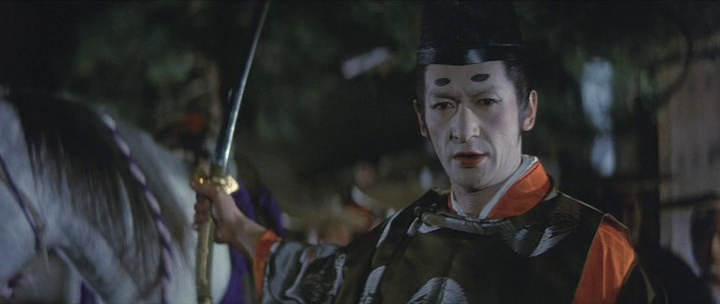
Though second billed, it’s hard not to forget we’re also watching a Sonny Chiba movie, and he can at times chew the scenery with the best of them. But he’s well cast here as Jubei (a character he’d go on to reprise in Samurai Reincarnation), especially because - though his father is a man in a position of responsibility and power - Jubei is almost a ronin at heart, a character more closely aligned to his wandering Negoro friends that anyone in the shogun’s court. If anything, Chiba’s Jubei is as close to an arbiter of justice in the film and his anger at times fits Chiba’s acting, as does his character in general. That said the cast is laden with very fine actors, some of which are intriguingly cast such a Tetsuro Tamba as a deadly but effete noble, a throwback to his usual tougher presence and there is of course the obligatory guest starring of Toshiro Mifune, in a role which he inhabits as easily as pie even if honestly he hasn't much to do with it except be Toshiro Mifune.
Shogun’s Samurai or The Yagyu Clan Conspiracy is an entertaining 130-minutes. It’s not quite prime Fukasaku but I do think much of that is the running time causing much of the story to become truncated, but it’s never baffling nor confusing and is effortlessly performed throughout by its cast. Fukasaku handles the scale of the film with ease just as he does the more emotional scenes or small chamber dramas that occur. He never loses the emotional focus of his characters, and it is often in these side dramas where this shines through, so it’s definitely another excellent addition to the Fukasaku releases that have been steadily appearing over the last several years and we can only hope for me.

Long-time anime dilettante and general lover of cinema. Obsessive re-watcher of 'stuff'. Has issues with dubs. Will go off on tangents about other things that no one else cares about but is sadly passionate about. (Also, parentheses come as standard.) Looks curiously like Jo Shishido, hamster cheeks and all.
posted by Richard Durrance on 12 Feb 2026
posted by Richard Durrance on 10 Feb 2026
posted by Richard Durrance on 07 Feb 2026
posted by Richard Durrance on 03 Feb 2026
posted by Richard Durrance on 27 Jan 2026
posted by Richard Durrance on 19 Jan 2026
posted by Richard Durrance on 08 Jan 2026
posted by Richard Durrance on 17 Dec 2025