
Written by Richard Durrance on 06 Mar 2026
Distributor NA • Certificate NA • Price NA
Seiji Tanaka’s Melancholic (released by Third Window) is sitting in my ever increasing top-watch pile; so perhaps my choosing of his 2024 film, showing in the Japan Foundation’s Touring Film Programme, The Man Who Failed to Die, would make up for this shameless omission?
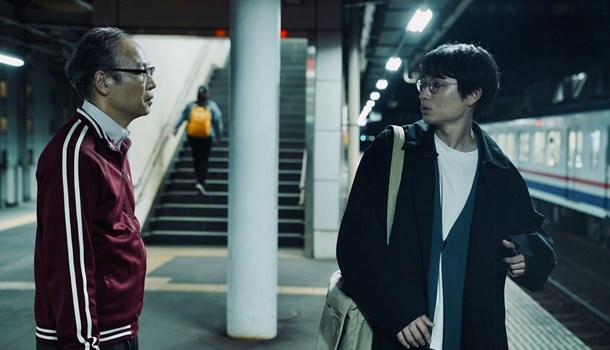
Comedy skit writer, Ippei (Katamari Mizukawa), has his life saved in a most unusual fashion. His attempt to jump in front of a train is foiled by the fact that someone else has had an ‘accident’ the stop before, causing the metro to shut down. Seeking out the man’s funeral, he attends and finds himself haunted by Moriguchi (Bokuzo Masana), the dead man’s ghost. The spectre wants him to kill the Wakamatsu (Yutaka Kyan), the ex-husband of his daughter Aya (Erika Karata) whose restraining order has just come to an end.
Some films you find yourself having to write about - some films you find you want to write about and The Man Who Failed to Die is definitely in the latter category. There’s a lot the film could do wrong, tonally and narratively in terms of its characters and their relationships. With only one passing exception The Man Who Failed to Die bypasses the potential pitfalls and instead creates a distinctly satisfying package.
Ostensibly the film has parallels with Ghost Killer, though these are paper thin. Both protagonists are haunted, both ghosts are obsessed with an act of violence and both ghosts can truly interfere with the real world – here Moriguchi can literally take Ippei by the throat. But this film is a very different beast, one which eventually becomes a deeply humane film and never allows itself to offer easy answers.
Moriguchi’s repeated demands that Ippei kill Wakamatsu, to protect his daughter, are the core of the film but also a vehicle to explore its characters. In death we see a father suddenly faced with the reality that his lone daughter may be at risk; his powerlessness to stop this is shown at his own funeral. A man approaches Aya at the very end of the funeral - we don’t immediately know who he is – at this point Moriguchi as a ghost has not even entered into the story, but in a quiet, now almost empty room enters a man, properly dressed, but fills the space with nuanced menace. Aya seems suddenly smaller, shrinking and becoming motionless. Though he is not aggressive, the casualness with which he asks if she’s okay, notes she’s moved and wants to know where she's living now. The scene is rife with unease, making your skin crawl far more effectively than outright intimidation. Later, Wakamatsu finds Aya clearing out her father’s house and, again, there’s the physical imposition, the suggestion of perfect politeness – he'll help her – yet the underlying refusal to accept her telling him not to, the insinuation of wanting to control her and the sense of implied intimidation is dripping with menace.
At this same point, outside the dead father’s home, with Moriguchi now revealed to Ippei, the scene becomes a case-study in how to write and perform, because though he's a stranger, Ippei is both ethically right to intercede as best he can, but is also in receipt of information he has no reason to know. Many writers might create a scene of masculine aggression but instead the worried father nervously shouts out the simple truth: Aya looks to be in distress. He provides a different focus for the physically imposing Wakamatsu, so that he might distract him away from Aya. And he does, at a physical cost to himself. There’s also an underlying realness to it because in a similar circumstance it’s hard to know what you could do, if this were something that were to happen to you. Ippei is a person, trying to find a way – while also being shouted at to kill Wakamatsu (which is plainly absurd).
Yet while this may all sound somewhat grim, the film is a very dry comedy. The humour travels well because it does not rely on laughter but on tone. The humour ensures that the more disturbing aspects never feel too overwhelming. Yet there is character development here, including that of our two leads, who start to find themselves in an almost undead buddy movie: Moriguchi finds himself interested in humour (and an undead writing partner) and gives Ippei someone that he can open up to – after all, he’s a man that wanted, perhaps, to die and has failed. Also The impact of all the men on Aya's life is laid bare too. In the final analysis, none of them do well by her. One wishes to control her, another is nice but when revealing the ghost must seem mad, and the dead, ghostly father’s obsession with murder takes a toll on her. Again this is handled well, never exaggerated but with a calm humanity that is rooted in her feelings and of those that wish to help and protect her.
The film is well crafted, knowing when to cut from a scene. When Ippei first meets the ghost, there’s the moment of humour – a second of screaming over the top WTFery - but it cuts straight to a static shot of the two – there's no need to show more of Ippei’s shock, the film’s done what it needs to in a moment, then moves on and it fits with the dry, deadpan humour throughout. Equally, when Moriguchi starts to bounce comedy skit ideas off Ippei, these are shown as montages with the focus on their excitement: the words don’t matter, it’s the enthusiasm that is generated that counts.
So, The Man Who Failed to Die is a comedy, with its focus in the real world, but with an ending that provides hope and an understanding of the dynamics of its characters. It would be easy for the film to try and generate a romance between Ippei and Aya but that would be false. Right from the start we know if he has an eye for anyone it’s unspoken and probably unknown to himself but clearly shown on screen. But let me return to the fact that as the film finished, its humour and humanity shone through. Of the first four films I have watched being shown at the JF TFP it was certainly the best and though the title may be about a man who failed to die, it's a film about men finding a reason to live, even if one of them is dead.
The Man Who Failed to Die is screening as part of the Japan Foundation's Touring Film Programme and screenings can be found here.

Long-time anime dilettante and general lover of cinema. Obsessive re-watcher of 'stuff'. Has issues with dubs. Will go off on tangents about other things that no one else cares about but is sadly passionate about. (Also, parentheses come as standard.) Looks curiously like Jo Shishido, hamster cheeks and all.

posted by Richard Durrance on 05 Mar 2026
posted by Richard Durrance on 02 Mar 2026
posted by Richard Durrance on 25 Feb 2026
posted by Richard Durrance on 12 Feb 2026

posted by Richard Durrance on 10 Feb 2026
posted by Richard Durrance on 07 Feb 2026
posted by Richard Durrance on 03 Feb 2026
posted by Richard Durrance on 27 Jan 2026